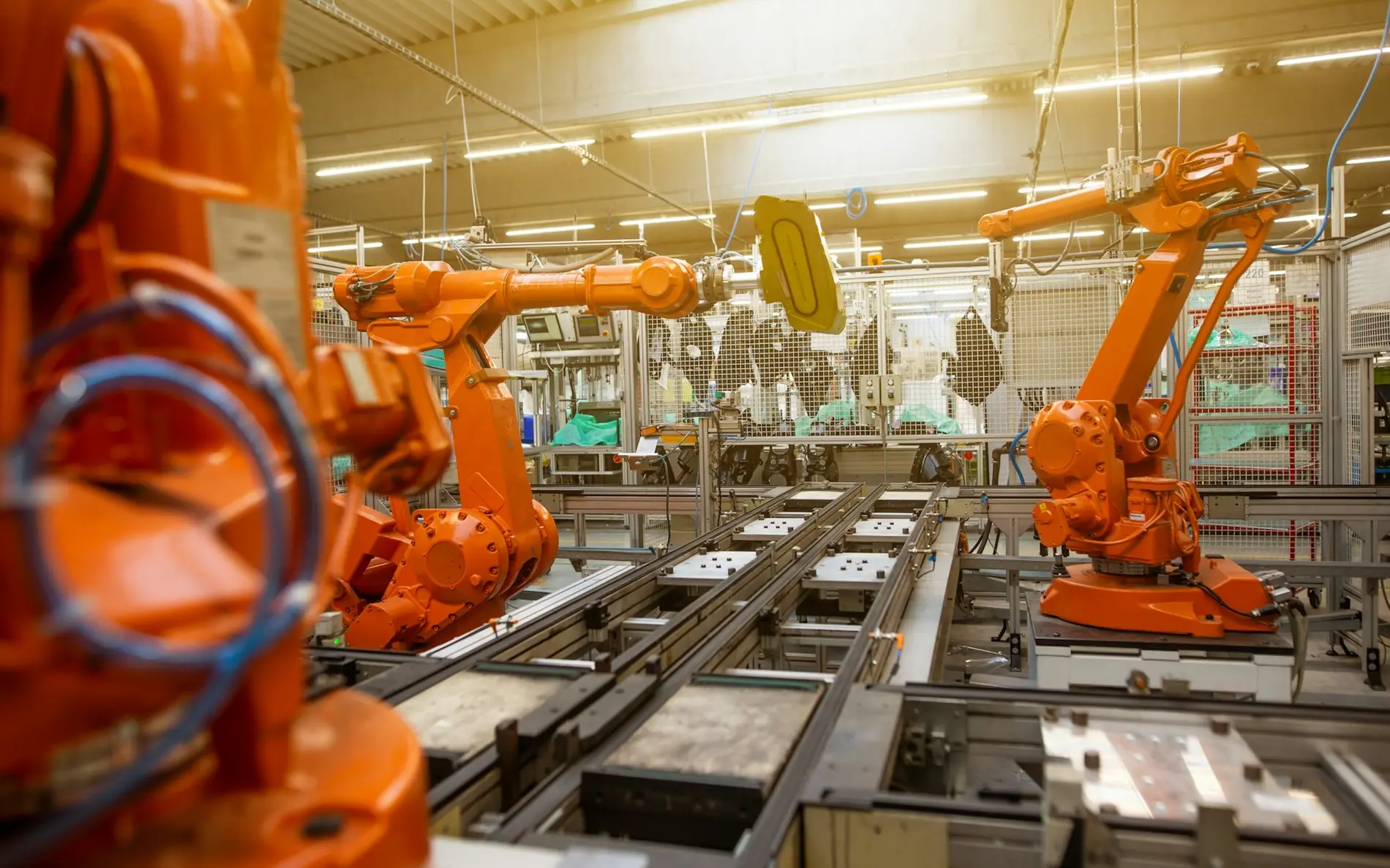
Know where transformation value is stuck.
Transformation Index reveals the constraint. Our data and AI advisory helps you make the decision, deliver the change and measure the result.
If you asked five people what this programme is for, would you get one answer or five?
Pick one and the other six follow. Three minutes, no account, and nothing is saved unless you ask.
Read it yourself, or bring someone in.
Most people take the reading first because it is free and takes three minutes. Some skip it and bring the decision straight to a call.
Transformation Index
Assess capability, see where the 7D chain is constrained and work from a brief grounded in your answers.
Take the seven questionsConsulting and fractional leadership
Get senior support to validate the finding, make the trade off and lead the change through delivery.
Request a callFind the step where value stops.
Transformation moves through seven gates. A strong capability further along the chain cannot pay off while an earlier gate holds it back. The Index shows the constraint; consulting helps move it.
Pick a gate to see the question it asks.
A real reading, not a mockup.
A page from a completed assessment. Every figure is computed from an answer somebody gave, and opens onto it.
- Every answer says whether it rests on a belief, an example, a document or a record
- One action per page, with the person who has to take it
- The brief, the full report and the board deck come from the same figures
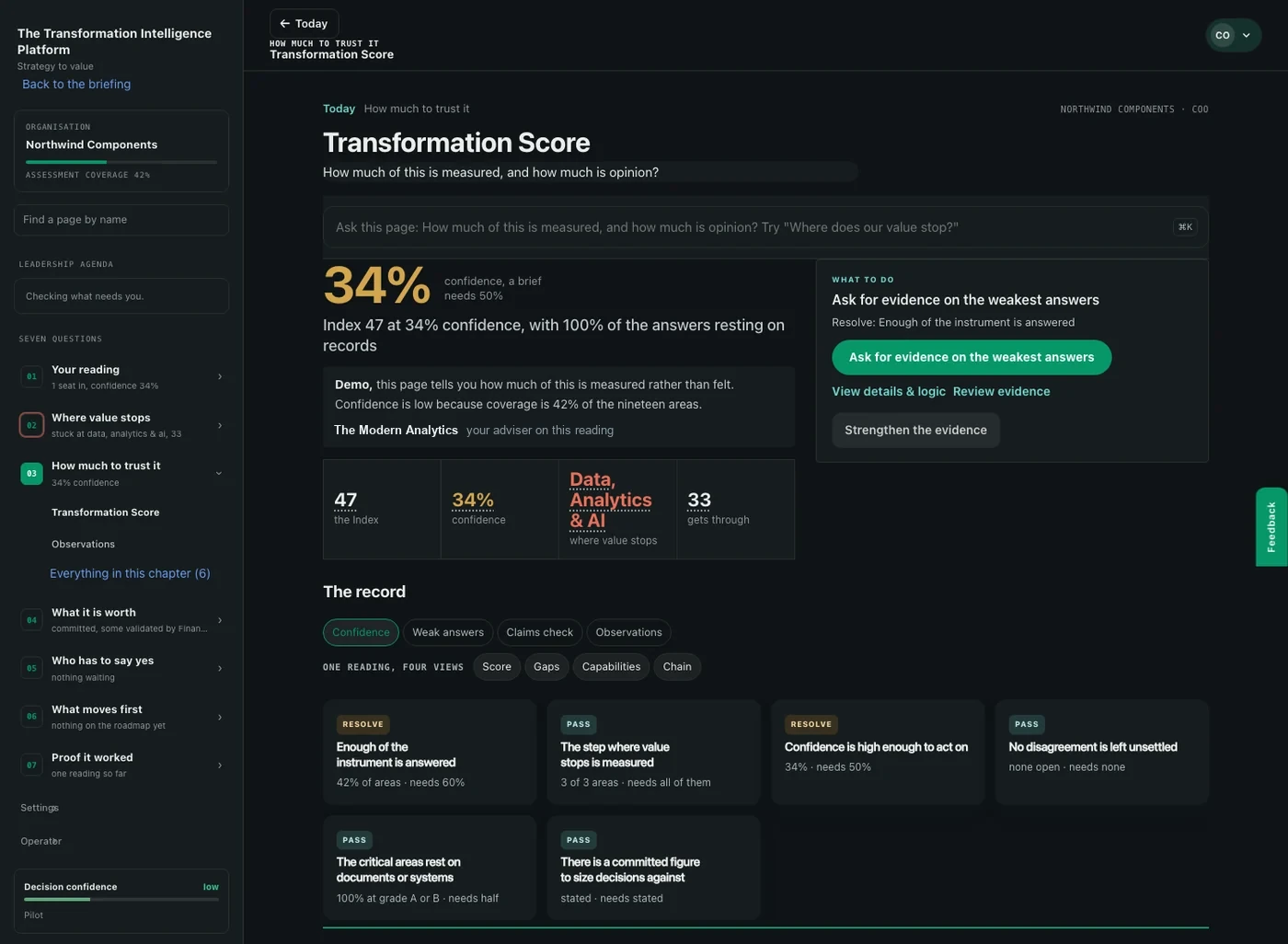
One instrument, two views. The 19 dimensions show what is weak. The ordered gates show where that weakness stops the money.
Read the full methodExperience built inside the work.
Six programmes in industrial technology, life sciences and banking. Each began with a different problem and ended with a number somebody could check.
Global industrial technology manufacturer
One operating model. More disciplined investment.
A three year roadmap agreed with the C suite, tied to growth and efficiency targets the business had already committed to.
Global industrial technology manufacturer
One platform, called OneData, instead of many extracts.
Every source brought into one place, with one definition per measure, so the same question stopped returning different answers depending on who ran it, and no single person was left carrying the whole thing.
Global pharmaceutical company
The constraint was adoption, not capability.
An enterprise BI platform and a $12M analytics portfolio across drug development, where adoption did not match the investment.

Global industrial technology manufacturer
Attribution came before removal.
Consumption stops being abstract the moment it carries an owner's name, and what nothing depends on was cheap to switch off.

Global industrial technology manufacturer
Governance first was not caution.
It was the only way the agentic work got approved to run at all.
Commercial bank
Starting from zero is easier than fixing one that has defenders.
Fifteen months building an analytics function inside a global services organisation.
Results achieved in a prior professional role, not as a client engagement of The Modern Analytics.
Regulated environments, mostly. Places where governance decides whether you go live at all.
Industrial manufacturing
Where investment happens in pockets and nobody can see the whole.
Read the case
Life sciences and healthcare
Where the reasoning behind a decision has to survive an audit.
Read the case
Banking and financial services
Where a model that cannot be explained does not ship.
Read the caseProgrammes run inside the business, not from the outside.
Data, analytics and AI programmes led inside industrial technology, life sciences and financial services, including TE Connectivity, Novartis and Silicon Valley Bank. Those were roles inside those businesses, not engagements of The Modern Analytics, which is why every figure on this page says where it came from.
People, process and technology.
Twelve things we are asked to do, sitting in the part of the business each one actually fixes. Under every group is what it has already delivered.
People
Who decides, who owns it, and who ends up using it.
Done before: a 50+ person delivery team, 25,000 users, adoption taken from 46 to 88 percent.
Process
How work gets chosen, queued and finished.
Done before: one intake across 20+ products, 1,500 hours a year handed back to the business.
Technology
What gets built, how it runs, and what it costs to keep.
Done before: 20+ solutions live, $1.1M+ of licence cost removed, 8 models in production.
Before you start.
Five questions people ask first: whether an account is needed, what happens to the answers, how this differs from a maturity model, who should answer, and what it costs.
Bring the decision that is not moving.
We’ll help identify what evidence is missing and whether the Index or a focused engagement is the right next step.
Request a 45 minute callusually within two working daysCommercial bank
Starting from zero is easier than fixing one that has defenders.
- Demand intake, standards and an operating rhythm built from nothing
- Automation applied where the hours actually were
- A function that kept running after the person who built it moved on
Global industrial technology manufacturer
Governance first was not caution.
- Conversational AI and agentic workflows put into production
- Eight models under a governance regime a regulator could read
- Manual monitoring cut by more than half
Global industrial technology manufacturer
Attribution came before removal.
- Every legacy asset given a named owner before anything was removed
- Consumption traced, so the unused was obvious rather than argued about
- Modernisation funded by what the removal released
Global pharmaceutical company
The constraint was adoption, not capability.
- Governed self service standardised across every region
- The drug development data and AI function built inside the centre of excellence
- Delivery improved through automation rather than headcount
Global industrial technology manufacturer
One platform, called OneData, instead of many extracts.
- Every source into OneData, each domain with a named owner
- The platform had come to rest on one person who owned everything, so ownership was split across named domain owners, written down and handed over
- Churn prediction, dynamic pricing, segmentation, demand forecasting, opportunity scoring and predictive inventory built on it
Global industrial technology manufacturer
One operating model. More disciplined investment.
- A fifty person cross functional team across India, the United States and Europe
- Demand governance that removed thirty per cent of low value initiatives from a $17M portfolio
- Saying no in public, which is where most of the money was
Technology
- Bring the data togetherOne platform, called OneData, one definition per measure, a named owner per domain
- Build the analytics and AI productsForecasting, pricing, segmentation, scoring, and BI people actually open
- Put AI into production safelyGovernance a regulator can read, and a way back when it is wrong
- Cut licence and platform costAttribution first, then removal, then modernisation funded by the saving
Process
- Find the use cases worth doingDiscovery, sizing, and the ones to stop before anybody builds them
- Prioritise the portfolioSequenced by the value each move releases, not by who asked loudest
- Manage demand properlyOne intake, one queue, and a no said in public with a reason
- Fix where the process stallsUsually between two teams, and usually nobody owns the gap
People
- Set the direction and the roadmapStrategy, investment choices and targets the business already owns
- Streamline the operating modelRoles, forums, decision rights and the rhythm that keeps them honest
- Build the execution modelPods, named owners, milestones, and how delivery is governed
- Lead the transformation and its adoptionDelivery leadership, change, and whether people are still using it in month six
Before you start
Do I need an account to see anything?
No. The seven questions run on the page and the signal is computed there. An account is only needed for the full reading of nineteen dimensions, and you can leave without saving anything.
What happens to the answers we give?
They stay in your own workspace. Nothing is copied anywhere else, nothing trains anything, and you can delete the workspace and everything in it at any time.
How is this different from a maturity assessment?
A maturity model says what is weak. The same answers read as an ordered chain say where value stops, which is what tells you what to fund first. Every figure also carries whether it rests on a belief, an example, a document or a record.
Who should answer it?
Whoever carries part of the transformation, not only the top table. Each function is routed its own questions, and where two people disagree the difference is recorded as a finding rather than averaged away.
What does it cost to go further?
The workspace starts at ₹2,999 a year and the brief stays free. Engagements are fixed scope and fixed fee, agreed in writing before anything begins.
Briefly
- Indian School of Business
- Chief Digital and AI Officer
- Texas McCombs
- AI for Leaders, postgraduate
- Computer Science
- BTech
- Databricks certified
- Data engineering, generative AI, machine learning
- Also
- AWS, Alteryx, SAFe, Scrum
None of that is why you would hire us. It is here because somebody always asks.
Three minutes to find the question worth six weeks. Seven questions, and no account to set up.
Take the seven questions Request a 45 minute call